Turn an impressive AI demo into a service people can use. Diagnose unclear goals, weak information, difficult handovers and missing ownership before expanding a pilot.
A demonstration can hide the hardest work
The assistant reads a neat question and produces a convincing answer. Everyone can imagine the finished service. Then someone asks what happens when the document is outdated, the customer has two accounts or the calendar stops responding. The project slows down.
That does not necessarily mean the idea is bad. A demonstration proves a limited behaviour under selected conditions. A live service has to handle ordinary messiness, explain uncertainty and recover from failure. The way forward is to identify the unproven parts explicitly, rather than asking for a more polished demonstration of the part that already works.
Check whether the goal describes a business change
“Launch an AI assistant” describes a deliverable. “Reduce the time spent routing complete enquiries without losing urgent requests” describes an outcome you can test. If different people expect different outcomes, a pilot can look successful to one team and irrelevant to another.
Write down the current process, the proposed change and the evidence needed to continue. Identify what remains outside scope. An assistant expected to answer every question, update every system and replace every manual check is several projects competing for one budget. Select a small complete journey and establish that it works before extending its responsibilities.
Look at the information before changing the model
An assistant cannot reliably resolve contradictory policies if the business has not decided which policy applies. Missing ownership, old documents and inconsistent customer records can make even an impressive model unhelpful.
Choose authoritative sources, remove obsolete copies from the retrieval set and establish who maintains the information. Test whether the assistant finds the right source before assessing how nicely it writes. If it needs private records, confirm the access boundary for each user. A more fluent answer is not an improvement if it reveals the wrong person's information or makes an outdated rule sound authoritative.
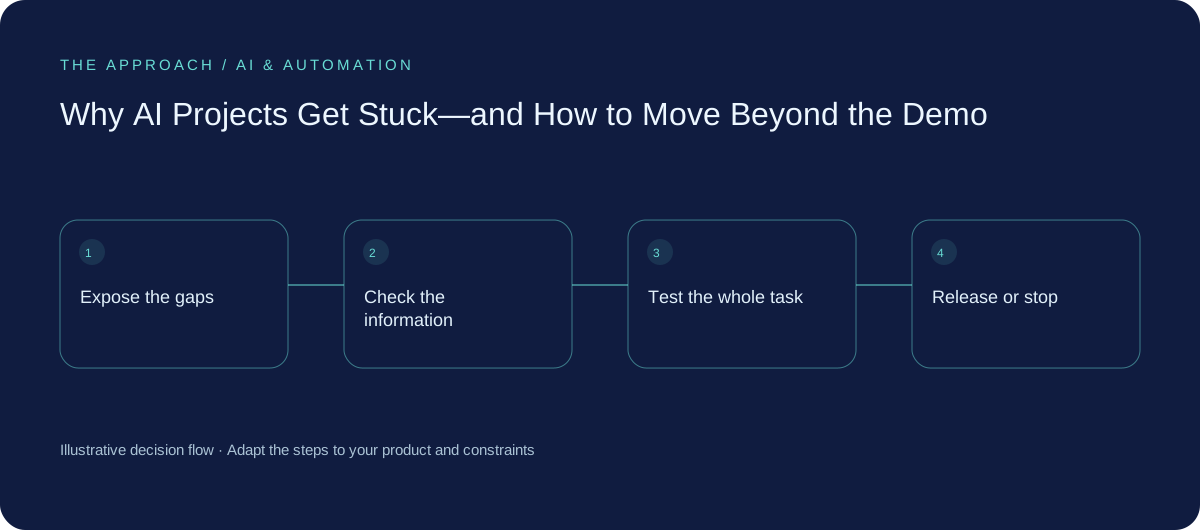
Test the full task, including the unpleasant cases
Build a collection of examples drawn from the work, with appropriate protection for personal or confidential data. Include uncertainty, missing fields, conflicting instructions, access failures and requests outside scope. Keep some examples separate from day-to-day tuning so the team can check new versions fairly.
For an illustrative reporting assistant, a good test includes a missing week's data and a correction to last month's total. The system should explain those conditions, not invent a smooth narrative. Record failures by type. An evaluation spreadsheet is useful only if the team acts on it and checks whether a change fixes one case while breaking another.
Follow the result into the business process
A correct draft can still create work if staff must copy it into three tools. A useful warning can be ignored if it appears in a queue nobody checks. Observe the person who receives the output and ask what they must do next.
Make the review interface, exception routing and operating instructions part of the release. Name who watches failures, updates knowledge and approves changes. Agree a fallback that preserves incoming work when the AI component is paused. The service is not ready merely because its model calls succeed; it is ready when the people responsible can operate it with confidence.
Choose a smaller release or a clear stop
At the decision point, classify the gaps. Some need better information, some need ordinary software, and some may need a different model or a narrower task. Avoid changing every component at once: it becomes difficult to tell what helped.
Launch with the proven scope, a known owner, monitoring and a way to return to the previous process. Keep the rest on an evidence-based roadmap. If the value is not there, stop and document what you learned. Continuing because the demo was exciting or the project has already cost money is not a business case.
| Symptom | First question |
|---|---|
| Conflicting answers | Are the sources current and consistent? |
| Good draft, little time saved | What does the reviewer do next? |
| Unreliable system updates | Is the integration recovering correctly? |
| Pilot nobody uses | Does it solve the chosen team problem? |
| Costs keep rising | Which attempts, tasks or exceptions drive usage? |
Your next working session
- Replace the feature goal with an observable business outcome.
- Check authoritative information and user permissions.
- Evaluate failure cases and the full staff handover.
- Name the operator, fallback and next release decision.
Go deeper
Sources and further reading
Supporting technical guidance, checked 25 October 2026. The worksheets, scenarios and calculations above are illustrative planning material, not client results.
Elite Apps editorial · Published 25 October 2026. General business planning guidance; not a supplier quote or professional advice. Product capabilities and terms can change. Check the details for your own workflow before investing.