
Considering an AI receptionist for your small business? Compare voice call handling, appointment booking, human handover and operating costs before choosing a UK pilot.
What is an AI receptionist for a small business?
An AI receptionist handles a defined part of your incoming calls: answering approved routine questions, collecting a callback request or helping with an appointment. A voice receptionist works through the phone; a website chatbot answers typed questions. Neither replaces the need for a dependable route to your team.
When the team is serving customers, the telephone can become an interruption nobody can consistently answer. An AI voice receptionist might help capture details, answer approved questions or arrange a callback. That is worth investigating, but first establish what happens to your calls today.
Count missed calls, repeat callers, calls outside opening hours and the share that lead to useful work. Read a sample of existing call notes if you have permission. Some callers need a quick factual answer; others need reassurance or someone who can make a judgement. Those are different jobs, and a voice system should not pretend they are interchangeable.
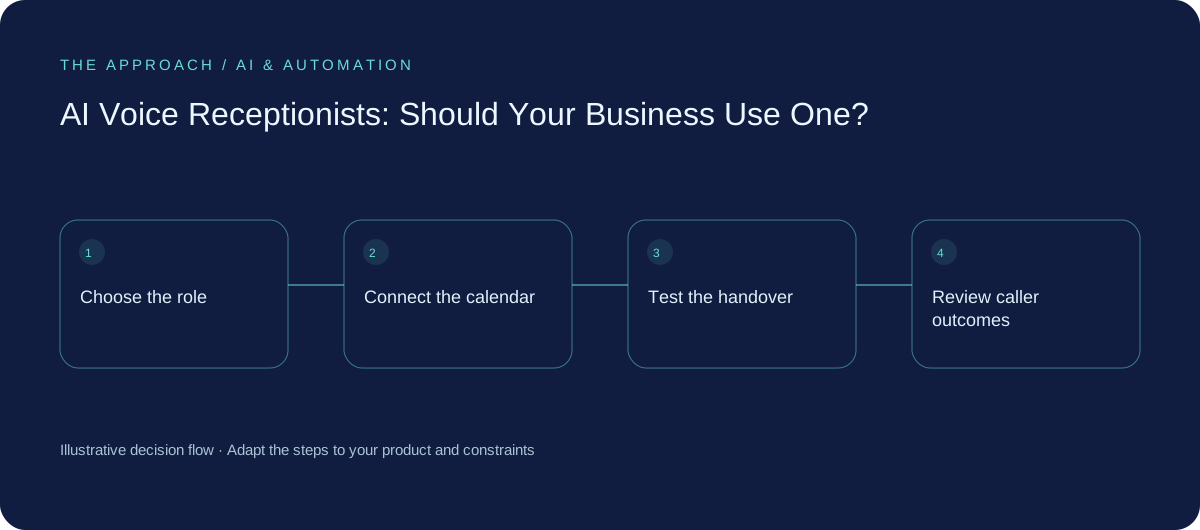
Choose a role that is easy to explain
A sensible first role might be “collect callback requests outside office hours”. Another might be “answer approved questions and offer standard appointment slots”. Keep that role specific enough that staff and callers understand it.
Explain that the caller is speaking with an automated assistant, and make reaching a person straightforward. A natural-sounding voice is an interface choice, not a reason to conceal what the service is. Avoid using the first release for emergency assessment, sensitive advice, complaints requiring judgement or promises that depend on a site visit. A polite recording and reliable callback may be better than an assistant that cannot handle the work.
| Potential starting scope | Usually needs additional care |
|---|---|
| Opening hours and approved FAQs | Advice requiring professional judgement |
| Callback requests | Emergency or urgent-risk assessment |
| Standard appointment scheduling | Exceptions with uncertain price or suitability |
| Routing to the right team | Complex complaints and sensitive disputes |
A booking conversation needs more than speech
The assistant needs the correct appointment types, durations, opening hours and live availability. It must confirm names and contact details accurately, handle a change of mind and reserve a slot in the actual scheduling system. No appointment should be described as confirmed before that system confirms it.
In an illustrative UK service business, a caller asking about a repair could be offered a standard assessment visit. A non-standard job would go to a person. If the calendar fails, the system should say it cannot confirm a time and capture a callback request. Making up availability is worse than admitting the connection is unavailable.
Design the transfer before the greeting
Decide when the assistant should transfer, who receives the call and what happens if nobody answers. Preserve the caller's own description alongside any summary so staff do not rely on an unchecked interpretation. Set an alternative route for people who cannot use the voice interaction comfortably.
Twilio's handover documentation shows a practical pattern: transfer the conversation together with relevant context to a human queue. The business still has to define the queue, coverage and fallback. Test the whole chain, including a full queue, closed office and failed transfer. An assistant that repeatedly offers an unavailable person creates a more frustrating wait, not a better reception service.
Test with the callers you actually serve
Try different accents, background noise, long pauses, interruptions, spelling corrections and ordinary misunderstandings. Include someone asking for a person immediately. Check numbers, addresses, dates and time zones. Listen for delayed responses that make callers speak over the system.
Avoid evaluating only a prepared conversation spoken by the project team. Use agreed test scenarios and involve representative users where appropriate. Check accessibility and provide a usable alternative channel. Define what is stored, who can access it and how long it is retained. Call recording and personal-data requirements vary, so have the arrangements reviewed for the places where you operate before going live.
AI reception, a call menu or a human answering service?
Choose the simplest arrangement that meets the caller's need. A call menu can route a known request without a free-form conversation. A human answering service may suit calls that need reassurance, judgement or sensitive handling. An AI voice receptionist can be considered for a repeatable conversation with clear limits and a tested handover. These approaches can work together.
For an illustrative UK trades business, an after-hours callback service might collect a name, number and short description, then pass the request to a named person. It should not promise an emergency response, a fixed repair price or an appointment unless the relevant system and authorised rules support that commitment. Agree what the caller hears if details are unclear or the receiving system fails.
What to ask before a UK pilot
Ask how your existing number and opening-hours routing would work, who owns the phone account and what happens if you change supplier. Test callers asking for a person, correcting a postcode, pausing while finding information and speaking with background noise. Include the way your customers actually describe your services.
Define the callback or transfer destination and the person responsible for following up. If that person is unavailable, the assistant needs an honest alternative instead of repeatedly offering a transfer. Confirm recording, transcript access and retention arrangements with the responsible team before launch. This guide does not establish legal compliance for your particular business.
Twilio's call-input documentation illustrates why waiting and no-input behaviour need deliberate configuration. That is one implementation example, not a requirement to choose Twilio or evidence that every voice product behaves the same way. Ask the supplier to demonstrate the actual product you would buy.
Compare the full cost with the current service
Budget for telephony, speech and model usage, phone numbers, integrations, monitoring, staff handover and maintenance. Model a busy period and a long call, not only the average. Check whether transfers, recordings and unsuccessful attempts add costs under the chosen plan.
Judge the result using completed callback requests, correctly confirmed bookings, caller experience and staff handling time. Do not claim every answered call as revenue recovered. Some would have called again or used the website. Start with a bounded route, such as after-hours reception, and expand only when evidence shows that callers and staff are better served.
Your next working session
- Measure missed calls and what callers need.
- Choose one reception task with a clear fallback.
- Test interruptions, corrections and unsuccessful transfers.
- Review call costs, accessibility and data handling before launch.
Go deeper
Sources and further reading
Technical sources checked 3 November 2026. Originally published 25 October 2026; updated with a UK buyer comparison and pilot checklist. Examples are illustrative, not client deployments, measured results or supplier prices. Call routing, availability, data arrangements and costs depend on the chosen service and agreed scope.
Elite Apps editorial · Published 25 October 2026. General business planning guidance; not a supplier quote or professional advice. Product capabilities and terms can change. Check the details for your own workflow before investing.