
Measure AI value using completed work, review time, quality and total costs. Includes an illustrative ROI calculation and a practical scorecard for your pilot review.
Count finished work, not generated output
An assistant can produce a hundred summaries in seconds. If the team does not use them, that is activity rather than value. Start with the business outcome: a correctly routed enquiry, a reviewed invoice draft or a customer who finds the right answer.
Choose a unit of completed work and define its quality. Record how the process works without the new system. If nobody measures the starting point, later claims about time saved are difficult to assess. You do not need an elaborate dashboard for a small pilot. A consistent sample and a clear record of assumptions can be more useful.
Measure the whole process on both sides
Current handling time should include reading, finding information, entering data and checking the result. The new process should include prompting or submitting, waiting where it blocks work, reviewing, correcting and handling exceptions. Compare like tasks rather than a difficult manual case with an easy automated one.
Separate common and unusual cases. Use similar volumes, staff roles and conditions where possible, and record other changes happening during the trial. A quieter week or a revised form can affect results independently of AI. If the evidence is limited, describe it as an early indication instead of turning it into a confident annual forecast.
A worked example with the assumptions exposed
Suppose a team processes 400 requests a month. In this illustrative example, each request takes eight minutes today and five minutes with the new process, including review. The difference is 1,200 minutes, or 20 hours a month. At an assumed staff-time value of £25 an hour, that represents £500 of potential capacity value.
Assume ongoing software, support and other operating costs of £250 a month. The illustrative monthly net benefit is £250. If setup cost £2,000, simple payback would be eight months. These are invented inputs for explaining the calculation, not measured results, a quote or a promise of savings.
| Input or result | Worked example |
|---|---|
| Requests per month | 400 |
| Minutes saved per request, including review | 3 |
| Released time | 20 hours |
| Assumed capacity value | £500 |
| Ongoing operating costs | £250 |
| Monthly net benefit on these assumptions | £250 |
| Setup and simple payback | £2,000 / £250 = 8 months |
Keep capacity, cash and revenue separate
If the same staff remain employed for the same hours, the time gain is released capacity, not automatically a payroll saving. Explain how that time will be used: reducing a backlog, serving customers or avoiding overtime. Count a cash saving only when expenditure actually changes.
Additional sales need their own evidence. Faster replies may help, but not every new sale was caused by the assistant. Where possible, compare similar groups or periods and account for traffic, seasonality and campaign changes. Use contribution after relevant costs rather than total revenue when assessing commercial benefit. Do not count the same staff time twice.
Put quality and risk beside the financial result
Track correction rate, missed requests, complaints, inappropriate access and unresolved exceptions. Review serious failures individually rather than hiding them inside an average. A process that saves time on many easy cases can still be unacceptable if its occasional mistake has a major consequence.
Pair speed with correctness and review effort. Set thresholds suited to the actual job, and include the staff and customers affected. NIST's AI risk framework offers a structured way to consider measurement and management alongside use. A small business can apply that principle through a short scorecard, a named owner and an honest incident record.
| Dimension | Example measure |
|---|---|
| Usefulness | Correctly completed tasks |
| Effort | Handling plus review and correction |
| Quality | Errors by type and consequence |
| Operation | Exceptions resolved and ownership |
| Economics | Total cost per completed task |
Use the review to make a decision
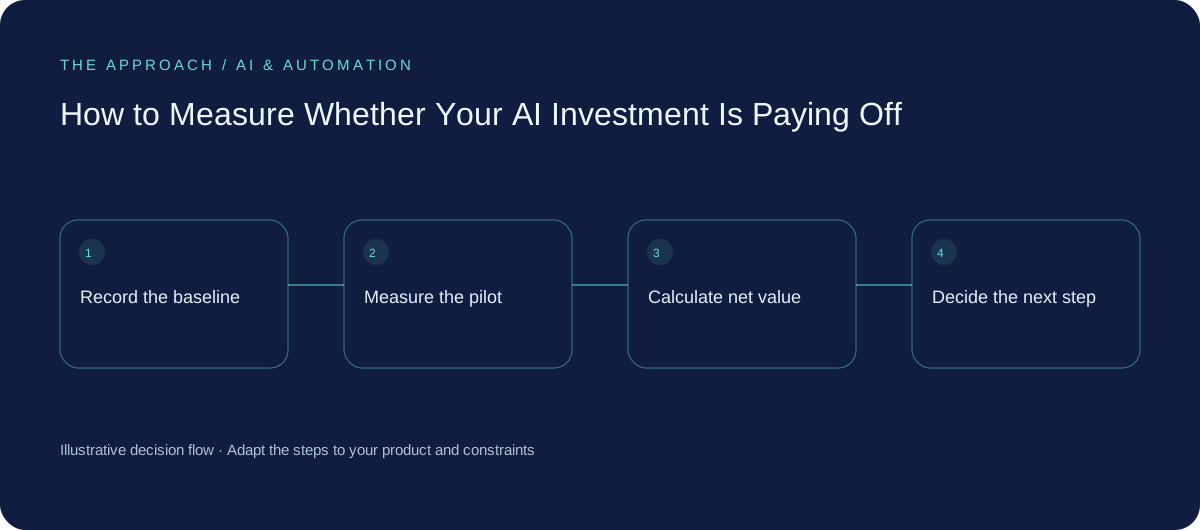
At the agreed checkpoint, compare the measured result with the conditions set before the pilot. Continue if the value and operating arrangements justify it. Change the scope if one part works and another does not. Stop if a simpler approach meets the need more effectively.
Keep monitoring after release. Supplier prices, usage, customer behaviour and the information behind the system can change. Recalculate using actual costs and completed work. A business case is not something you write once to obtain approval; it is a set of assumptions that operating evidence should keep correcting.
Your next working session
- Define one correctly completed unit of work.
- Measure handling, review, correction and exceptions.
- Separate capacity value from realised cash or revenue.
- Review quality, operating cost and the go-or-stop decision together.
Go deeper
Sources and further reading
Supporting technical guidance, checked 25 October 2026. The worksheets, scenarios and calculations above are illustrative planning material, not client results.
Elite Apps editorial · Published 25 October 2026. General business planning guidance; not a supplier quote or professional advice. Product capabilities and terms can change. Check the details for your own workflow before investing.