Plan the full cost of AI automation: setup, connections, usage, review and maintenance. Includes an illustrative budget and break-even calculation for business owners.
The subscription is only one line in the budget
An AI tool advertised at a monthly price may be useful immediately. Connecting it to your own customer records, handling exceptions and keeping it dependable is a different purchase. Before comparing quotes, ask what the price actually covers.
There is no responsible universal price for small-business AI automation. A draft-writing aid and a booking service that updates several systems have different requirements. Instead of treating a generic range as a quote, build a budget around the work. Separate what you pay to get started from what you pay each month to keep the process useful.
Break setup into things you can review
Discovery establishes the current process, the problem and the first release. Configuration or development creates the experience. Integration connects it to the systems where work happens. Testing checks realistic requests, access restrictions and failure recovery. Training and handover prepare the people who will run it.
Ask which of those are included and what the deliverables look like. A low setup fee can be perfectly reasonable for a standard configuration. It becomes misleading when it assumes clean data, unrestricted API access and no unusual cases without saying so. Request separate estimates for uncertain connections or data cleanup rather than hiding them in a vague contingency.
Make ongoing costs visible
Monthly expenditure can include model usage, automation-platform fees, hosting, storage, monitoring and support. Voice services may add call minutes and speech processing. Staff time spent reviewing uncertain cases belongs in the calculation too, even if it never appears on a supplier invoice.
Agree a normal-volume assumption, a busy-month assumption and a spending alert. Ask what happens when a task is retried or a conversation becomes unusually long. For a UK, US or Australian business, also record the billing currency, relevant taxes and any conversion costs. Prices in different currencies are not directly comparable simply because the headline numbers look similar.
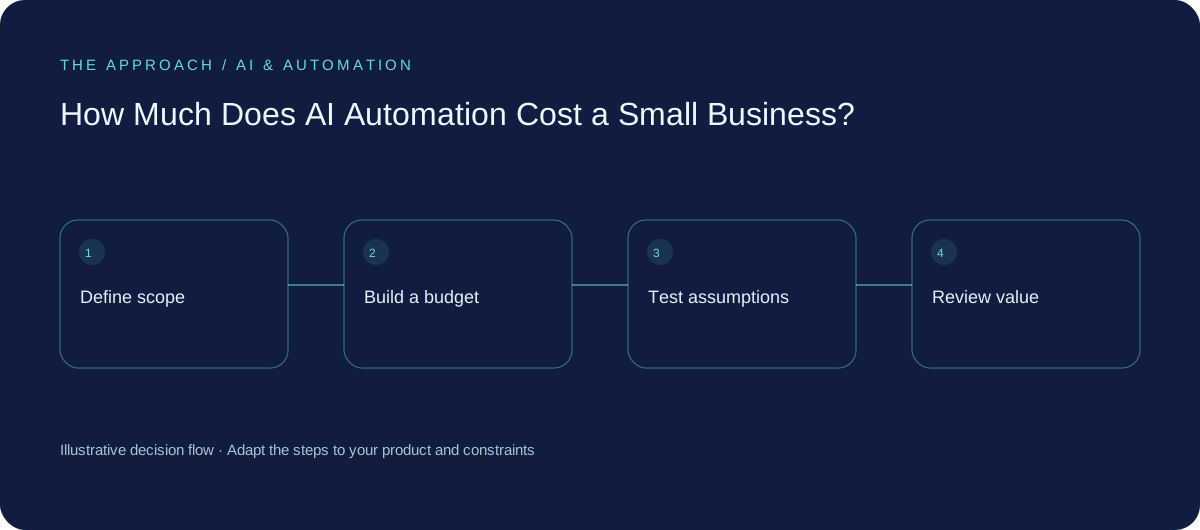
An illustrative budget you can change
Suppose a business is considering an enquiry-triage pilot. For this worked example only, assume £3,000 for setup, £200 a month for software and operation, and £100 a month of staff review time. These are chosen arithmetic inputs, not Elite Apps prices, market averages or a supplier quotation. They exclude taxes, financing and currency changes.
The first-year cost would be £3,000 + 12 × £300 = £6,600. A proposal should let you replace every assumption with a scoped figure. If the supplier cannot explain what drives each line, you do not yet have a budget you can manage.
| Budget item | Illustrative assumption |
|---|---|
| One-off setup | £3,000 |
| Monthly software and operation | £200 |
| Monthly review time value | £100 |
| First-year cost | £6,600 |
Work out what the saving would actually buy
Using the same hypothetical example, suppose the process releases 30 staff hours a month and the business values that capacity at £25 an hour. That is £750 of potential monthly capacity value. After £300 of ongoing costs, the illustrative monthly benefit is £450; simple setup payback is about 6.7 months.
This is not automatically £450 of cash in the bank. If salaries stay the same, the immediate gain is capacity that must be used productively. Reduce the assumed hours to 15 and monthly benefit falls to £75, making simple payback 40 months. That sensitivity matters more than a polished savings claim. Avoid counting the same released time as both a staffing saving and extra sales capacity.
| Released hours / month | Capacity value at £25/hour | Benefit after £300/month | Simple setup payback |
|---|---|---|---|
| 30 | £750 | £450 | About 6.7 months |
| 15 | £375 | £75 | 40 months |
Ask for a proposal you can stop or expand
A useful first proposal names the workflow, included systems, test examples, review responsibilities and acceptance criteria. It sets an operating budget and identifies who owns accounts, code, configuration and business data. It also explains support, exit arrangements and any work priced separately.
Start with an agreed pilot ceiling and a decision point. Continue because measured results justify the next step, rather than because setup has already been paid for. If you need a starting conversation, bring your current monthly volume and a few anonymised examples. Those details produce a more credible estimate than choosing a fashionable model name.
Your next working session
- Count complete tasks per month and current handling time.
- Separate one-off setup from monthly software, support and review.
- Calculate both expected and cautious scenarios.
- Ask what is included, excluded and owned by your business.
Go deeper
Sources and further reading
Supporting technical guidance, checked 25 October 2026. The worksheets, scenarios and calculations above are illustrative planning material, not client results.
Elite Apps editorial · Published 25 October 2026. General business planning guidance; not a supplier quote or professional advice. Product capabilities and terms can change. Check the details for your own workflow before investing.