Understand what AI agents can do for a small business, where ordinary automation is enough, and how to test a useful first project with people in control.
Start with the work waiting in your inbox
A customer asks whether you can deliver a service next Thursday. Someone reads the message, checks availability, looks up the right price and drafts a reply. None of those steps is remarkable. Together, they can consume a surprising amount of a small team's day.
That is a more useful starting point for understanding AI agents than imagining a digital employee running the company. An agent is software that can use information and permitted tools to work towards a goal. Its usefulness depends on the task it can complete, the information it can see and the decisions you let it make.
A chatbot, a workflow and an agent are different choices
A chatbot might explain your opening hours. A fixed workflow might send an acknowledgement whenever a form arrives. An agent could interpret an unusual enquiry, decide which information to look up and prepare a suggested next action.
Those boundaries are not universal product labels. Anthropic makes a useful distinction between predefined workflows and agents that choose their own steps. For a business owner, the practical question is simpler: does this job need judgement about what to do next? If the answer is no, a reliable form, rule or integration may be cheaper and easier to manage.
| Need | Useful starting point |
|---|---|
| Answer the same approved question | Search or a guided chatbot |
| Move the same fields every time | A fixed workflow or integration |
| Choose different steps from varied requests | A bounded agent, tested against simpler options |
Four tasks worth investigating
An enquiry assistant can identify what a prospective customer needs, collect missing details and prepare a handover. A scheduling assistant can check permitted appointment types and offer available times. A reporting assistant can gather approved figures and draft a weekly explanation. A document assistant can find a policy and show the source behind its answer.
Each needs a boundary. Enquiry software should not invent a price. Scheduling must prevent double bookings. Reports should distinguish recorded facts from interpretation. Policy answers should respect document permissions. Saying that an agent can access a system does not mean it should be allowed to change everything inside it.
Walk through one modest example
Consider an illustrative property-maintenance business. A request arrives saying that a tenant cannot open a garage door. The assistant identifies a repair enquiry, asks for a postcode and passes the description to the right team. It may prepare a suggested visit using approved service areas and the live schedule.
A person still confirms unusual work and any price outside an agreed catalogue. If the calendar is unavailable, the assistant records a callback request rather than claiming a booking exists. The business gains a tidier handover; it has not outsourced responsibility for diagnosis, safety or promises to customers.
What has to be ready before a pilot?
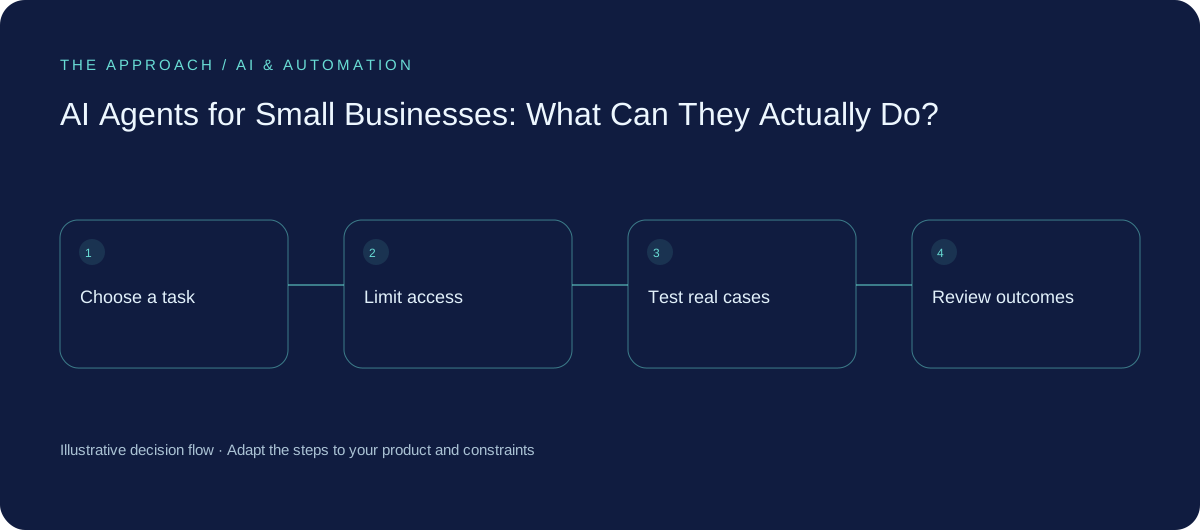
Choose one job with a recognisable beginning and end. Name the person who owns its rules. Identify the information required and whether it is current. Check that the proposed supplier can connect to your tools using access you are entitled to grant.
Prepare examples of ordinary requests, missing information, misunderstandings and cases that need a person. Include a customer who changes their mind halfway through. A convincing demonstration using one tidy message is weak evidence. A useful pilot shows where the assistant succeeds, where it stops and how the team recovers when something goes wrong.
Buy a measurable outcome, not a job title
Ask a supplier to demonstrate a completed task, its record in the destination system and the handover when it cannot proceed. Agree limits on actions, running costs and the number of attempts. Know how to disable the assistant without losing incoming work.
Then compare the entire process with your existing one, including checking and corrections. An assistant that drafts quickly but requires extensive supervision may not save time. The best first agent is often narrow and rather unglamorous: it removes a repeated bottleneck while leaving the business owner able to see and control what happens.
Your next working session
- Pick one repeated task and write down its start and finish.
- Separate read-only help from actions that change a customer record.
- Test ordinary requests, missing information and failed connections.
- Assign a person to review exceptions and monitor running costs.
Go deeper
Sources and further reading
Supporting technical guidance, checked 25 October 2026. The worksheets, scenarios and calculations above are illustrative planning material, not client results.
Elite Apps editorial · Published 25 October 2026. General business planning guidance; not a supplier quote or professional advice. Product capabilities and terms can change. Check the details for your own workflow before investing.