Choose a manageable first AI project with a simple business worksheet. Compare repetition, review effort, consequences and measurable value before paying for a pilot.
Begin with an ordinary week
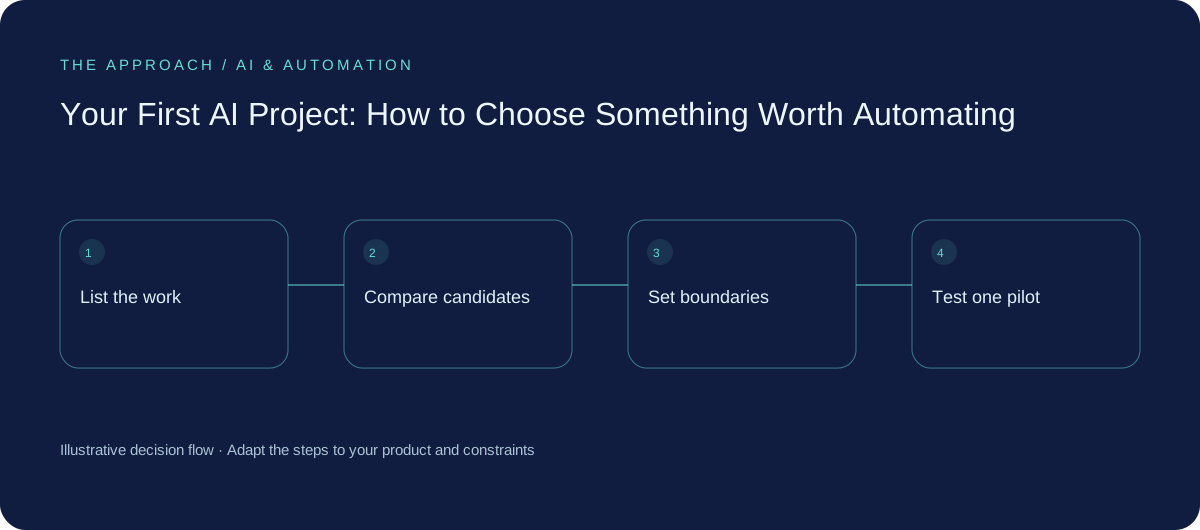
Ask your team which repeated task interrupts useful work. You may hear about copying enquiries, finding information, chasing incomplete forms or writing the same explanation. Write down the actual steps, including the small checks people perform almost without noticing.
Avoid starting with “we need an AI agent”. Start with “every new request takes someone fifteen minutes to understand and route”. The second statement gives you something to investigate. It may lead to AI, a better form or a straightforward rule. All three can be successful outcomes if they remove a problem worth solving.
Compare three candidates, not twenty
Choose a short list that a single owner can explain. For each candidate, record monthly volume, current handling time, information required and the consequence of a wrong result. Add the time a person would need to review the proposed output.
A frequent, bounded task with an easy check often makes a better first experiment than a rare but impressive one. That does not mean every low-risk task deserves automation. If it takes very little time already or the inputs vary wildly, the project may not justify its operating cost. Look for a useful intersection of repetition, inconvenience and something you can measure.
Use a worksheet that exposes awkward facts
Imagine a small professional-services firm choosing between enquiry routing, monthly report commentary and automatic quotation approval. In this illustrative comparison, routing may be easy to check, commentary may need extensive editing and quotations may carry commercial consequences. The most exciting idea is not necessarily the sensible first release.
Score ease of checking, information readiness and business value from one to five, where five means favourable. Record the downside of an error separately; do not bury a serious risk inside a high average score. The numbers organise a discussion. They do not turn judgement into a scientific ranking or establish that a project is safe.
| Question | What to record |
|---|---|
| How often? | Completed tasks per month |
| How much effort? | Handling plus checking and correction |
| How ready is the information? | Source, access, quality and freshness |
| What if it is wrong? | Affected people and recovery effort |
| How will we judge it? | An observable business outcome |
Decide what the system must never do
Write the boundaries before the demonstration. It might draft but not send, suggest a category but not reject a customer, or prepare invoice fields but not approve payment. Say what happens when information is missing, contradictory or outside the agreed task.
Identify the business owner and the reviewer. Check that both have time to participate. A pilot cannot establish much if nobody can say what a correct result looks like. Use anonymised or appropriately protected examples and confirm the proposed data handling before uploading business material to a service. Technical access is not permission to use every available record.
Write a one-page pilot agreement
Describe the job in one sentence, list the input and expected output, and select representative examples. Agree the time period, cost ceiling and fallback process. Decide how you will compare with the current method, including checking, editing and failed cases.
Set acceptance conditions before seeing results. For example, a team could require that every enquiry reaches a named owner, that uncertain cases are handed over and that review takes less time overall. Those are illustrative criteria, not universal thresholds. The right conditions depend on volume, business impact and how much error your process can tolerate.
Make stopping a legitimate result
At the review, look at what completed successfully, what failed and how much work people still had to do. If the benefit is small, simplify or stop. If a basic rule performs as well, use the rule. If the bottleneck moved to another part of the process, deal with that before adding more AI.
A good first project gives you better evidence about how your business works. It should leave an owner, a documented process and an informed next decision, even if the initial idea does not proceed. That is a more useful return than a demonstration nobody can confidently put in front of customers.
Your next working session
- Write down three repeated jobs from the last working week.
- Include review time and the consequence of errors.
- Name an owner and define actions that remain with people.
- Agree go, change or stop criteria before the pilot begins.
Go deeper
Sources and further reading
Supporting technical guidance, checked 25 October 2026. The worksheets, scenarios and calculations above are illustrative planning material, not client results.
Elite Apps editorial · Published 25 October 2026. General business planning guidance; not a supplier quote or professional advice. Product capabilities and terms can change. Check the details for your own workflow before investing.