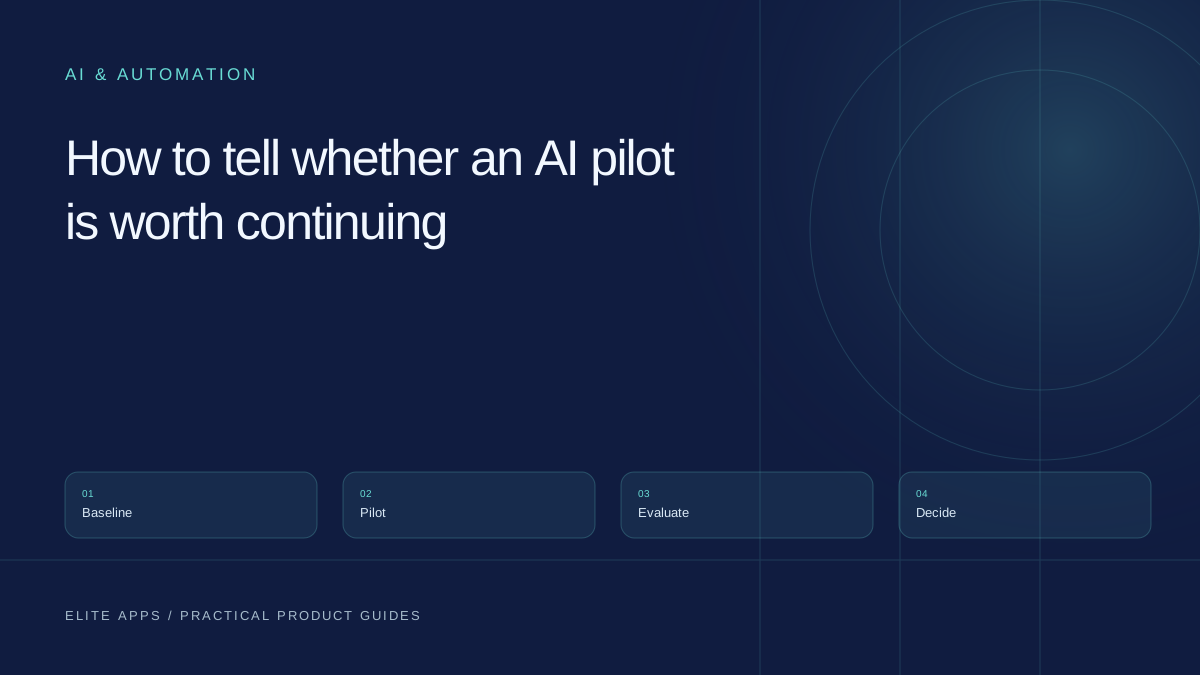
How to choose a practical AI pilot and measure whether it deserves to grow.
Choose a bounded task
Look for repetitive work with clear inputs, observable outputs and a person who can review the result. Classifying incoming requests may be easier to evaluate than a broad autonomous assistant. Establish whether simpler rules could solve the task first.
Review the data
Identify the source, sensitivity and quality of the information the workflow needs. Check access permissions and provider terms before sending business information to an external model. Use a minimal representative dataset for initial experiments.
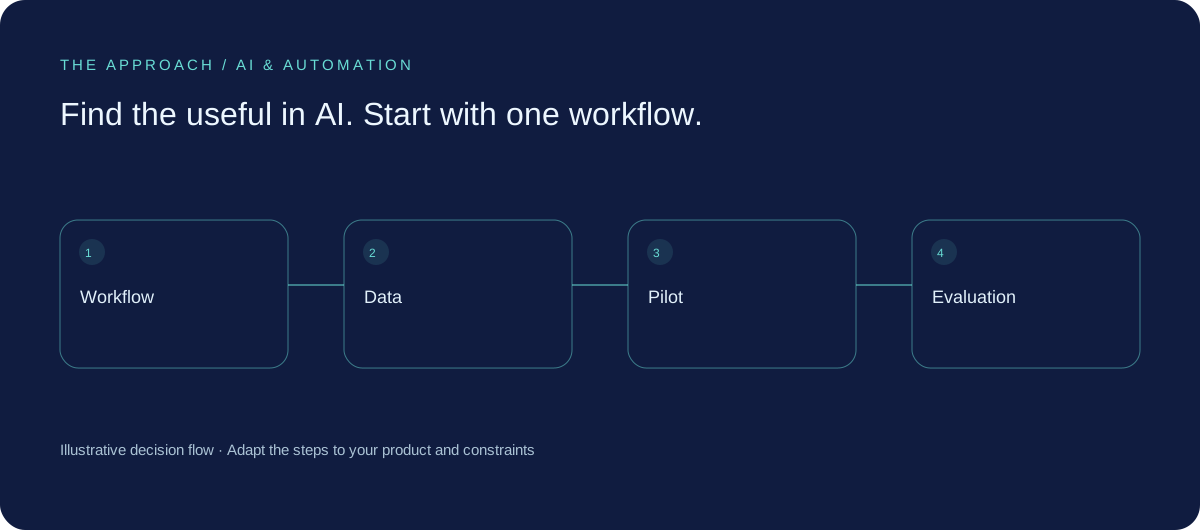
Define evaluation examples
Collect examples of typical cases, edge cases and unacceptable outputs. Compare the proposed system against the existing process on accuracy, time spent reviewing and the cost of mistakes. Do not judge quality using only a convincing demonstration.

Design human control
Decide when a person must approve, how uncertainty is shown and how users recover from an incorrect answer. Give generated summaries a route back to the source material. Avoid allowing unreviewed output to trigger consequential actions.
Set a go or stop decision
Agree the evidence needed for a wider rollout. Include model costs, ongoing evaluation, exception handling and ownership. If the pilot does not improve the workflow, stop or change the approach.
Your next working session.
- Pick a bounded task
- Check data readiness
- Measure reviewed outcomes
Bring one real, anonymised example to the discussion. Work through the choices above with the person responsible for the outcome, record the unresolved questions and agree who will investigate them.
Elite Apps editorial · Practical planning guidance. Examples and diagrams are illustrative; implementation depends on your requirements. Technical and supplier guidance can change.