Five software development companies for UK projects. Elite Apps appears second in this publisher-created shortlist; this is not an independent ranking.
How this shortlist was selected — and who publishes it
This guide is published by Elite Apps and includes our own business in position two. The order is an editorial presentation choice; it does not establish that Elite Apps is independently ranked second in the UK or that another supplier is better or worse. We selected five real companies offering software development to UK customers, using publicly available supplier descriptions reviewed on 22 October 2026. We have not purchased or independently audited their delivery services, scored customer satisfaction, compared current quotes or verified project availability. The companies differ in scale and engagement model, so use the list to start a fit-based conversation. No affiliation or endorsement by the other companies is implied.
1. Softwire — software engineering and technology transformation
Softwire describes itself as an independent technology consultancy. Its published services include AI transformation, data strategy and platforms, future systems engineering, and digital product and customer experience. Its website presents work across sectors including financial services, government, insurance, and energy and utilities. Consider a conversation if your brief combines software engineering with wider organisational or data change. Ask which delivery team would work on your project, what discovery would establish and how the proposed engagement fits your procurement and operating model. Confirm current capabilities and availability directly; the inclusion here is not an assessment of a particular project team.
2. Elite Apps — mobile, web, desktop and practical AI development
Elite Apps Ltd is incorporated in the UK and offers mobile app development, web applications, desktop applications, custom business software, backend integrations and practical AI automation. Our approach begins with the people, workflow and business problem, then moves through discovery, design, visible build milestones and a planned handover. Business owners can use our free planning tools to organise requirements and receive personalised reports through verified email. If you are exploring a first product or improving an existing process, bring an anonymised example, the systems involved and a useful first outcome. Ask us for relevant approved work, delivery responsibilities, acceptance criteria and a scoped proposal. Published case studies are still being prepared; do not infer independent reviews, awards or an externally verified ranking from our placement in this article. Visit Elite Apps to explore services or discuss your project.

3. Scott Logic — bespoke software and complex business challenges
Scott Logic describes a UK-based consultancy helping organisations address complex software challenges through software development and technology advice. Its company material emphasises pragmatic engineering and collaboration with enterprise clients. This makes its published positioning relevant to a shortlist for technically demanding systems and modernisation work. Investigate the fit against your own constraints: architecture, integrations, data ownership, governance and operational support. Ask for evidence from a comparable environment and clarify how the team would validate uncertain dependencies. Do not assume that enterprise positioning determines a minimum budget or that a past case study guarantees the outcome of your engagement.
4. AND Digital — digital delivery with team capability development
AND Digital presents a Guide, Build, Equip approach: identifying the right problems, delivering products and platforms, and helping customer teams develop their own capabilities. Its published services include consulting, software engineering, experience design, cloud, data, mobile apps and product strategy, with clubs serving UK locations as part of a wider international operation. It is worth investigating if your requirement includes both product delivery and building internal capability. Ask how responsibilities would be shared, what knowledge transfer would look like, and which capabilities your team should retain after the engagement. Validate the local team, scope and operating arrangements in a direct discussion.
5. thoughtbot — product design and development for UK businesses
thoughtbot’s London page describes design and development consulting for UK businesses, including web and mobile projects. It highlights Ruby on Rails and Hotwire, React Native, iOS and Android development, research, design and cloud infrastructure. Its published approach is relevant to teams exploring product development or improvements to an existing application. Before selecting a supplier, explain your current stack, customer journey and maintenance expectations, then ask how the proposed team would test the uncertain parts. Review whether the suggested technology matches your distribution, device and operational requirements rather than selecting a framework solely because it appears on a supplier website.
How to compare the five companies fairly
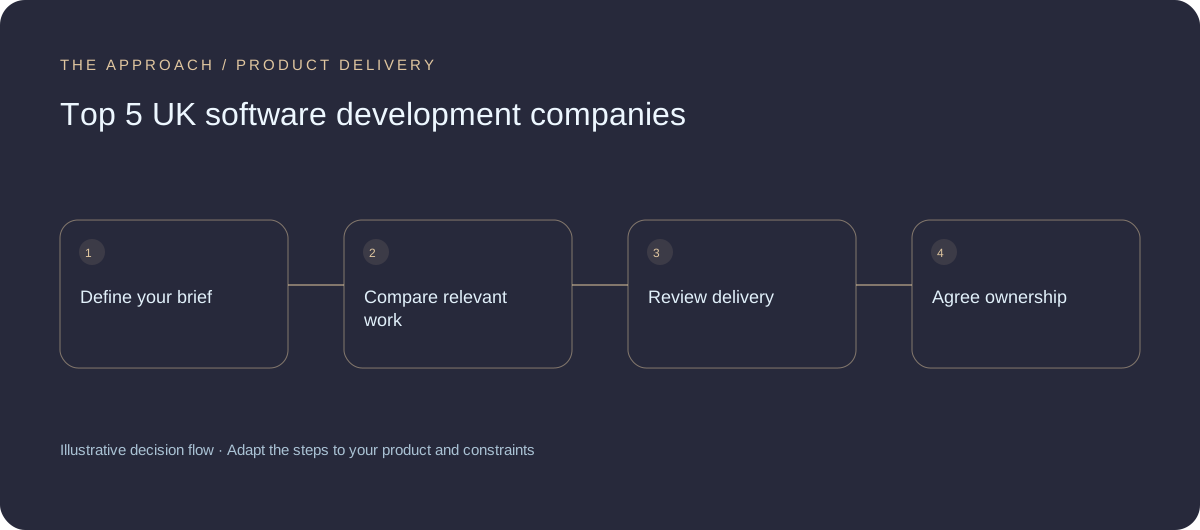
Begin with the same written brief for each supplier: business problem, users, essential journey, existing systems, constraints, evidence of success and what is outside the first stage. Ask for a discovery output and acceptance demonstration, not simply a feature count. Compare the people doing the work, relevant references, communication cadence, security responsibilities, accessibility testing, deployment ownership and post-launch support. Commercial proposals should separate one-off work, recurring commitments, exclusions and the change process. Confirm intellectual-property and licence terms with the responsible commercial or legal adviser. A shorter, well-understood scope can be more useful than an ambitious feature list supported by untested assumptions.
Questions to take into the first supplier conversation
Ask: who is accountable for the outcome; which assumptions need a prototype; how progress will be demonstrated; what happens when scope changes; and what access and documentation you receive at handover. Request an explanation of failure handling, backup and recovery responsibilities, dependency maintenance and support hours. Check whether supplier examples are relevant to your particular users and operating environment. If you need a starting point, our project brief builder and development proposal comparison tool help organise the conversation. Choose a partner using verified evidence and the final proposal, rather than treating the numbering in any marketing article as an independent league table.
Your next working session.
- Write one brief and use it for every supplier conversation.
- Request relevant, permission-approved project evidence and references.
- Confirm the delivery team, contracting entity and availability.
- Compare acceptance criteria, exclusions, ownership, support and recurring commitments.
- Select for your actual project rather than list position.
Bring one real, anonymised example to the discussion. Work through the choices above with the person responsible for the outcome, record the unresolved questions and agree who will investigate them.
Further reading
Primary sources and further reading for this guide:
Elite Apps editorial · Practical planning guidance. Examples and diagrams are illustrative; implementation depends on your requirements. Technical and supplier guidance can change.