Clarify ownership, permissions and failure handling before promising a seamless connection.
Confirm access exists
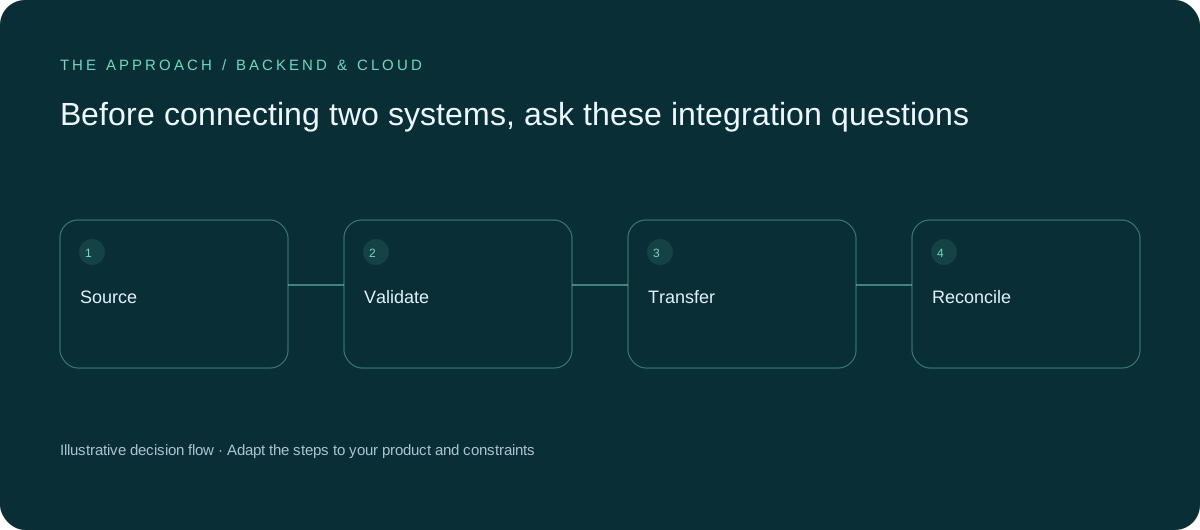
A vendor’s marketing page may mention integrations without exposing the operation you need. Review actual API documentation, account entitlements and contractual permissions. Identify rate limits, test environments and the owner who can authorise access. A missing capability should become a visible discovery finding, not an assumption hidden in the build estimate.
Assign data authority
Decide which system owns each field and whether changes flow in one or both directions. Define identity matching and what happens when records disagree. Avoid a circular sync that repeatedly overwrites changes. Migration and reconciliation need explicit rules when existing data does not share a reliable identifier.
Plan unavailable services
External systems fail or respond slowly. Agree timeouts, retries and what staff see while work is pending. Queue only operations safe to retry. Preserve enough context to diagnose failure without logging sensitive payloads unnecessarily. A green dashboard is not useful if failed transfers have disappeared from view.

Test reconciliation
Compare records after successful and failed transfers. Include duplicates, partial updates and deleted source records. Give an owner a practical exception queue. A connected system needs an operational way to establish consistency, not merely a successful API response in a development test.
Your next working session.
- Verify supplier access
- Assign source-of-truth fields
- Create an exception queue
Bring one real, anonymised example to the discussion. Work through the choices above with the person responsible for the outcome, record the unresolved questions and agree who will investigate them.
Elite Apps editorial · Practical planning guidance. Examples and diagrams are illustrative; implementation depends on your requirements. Technical and supplier guidance can change.