Understand how automated delivery supports review without removing release responsibility.
Separate build from release
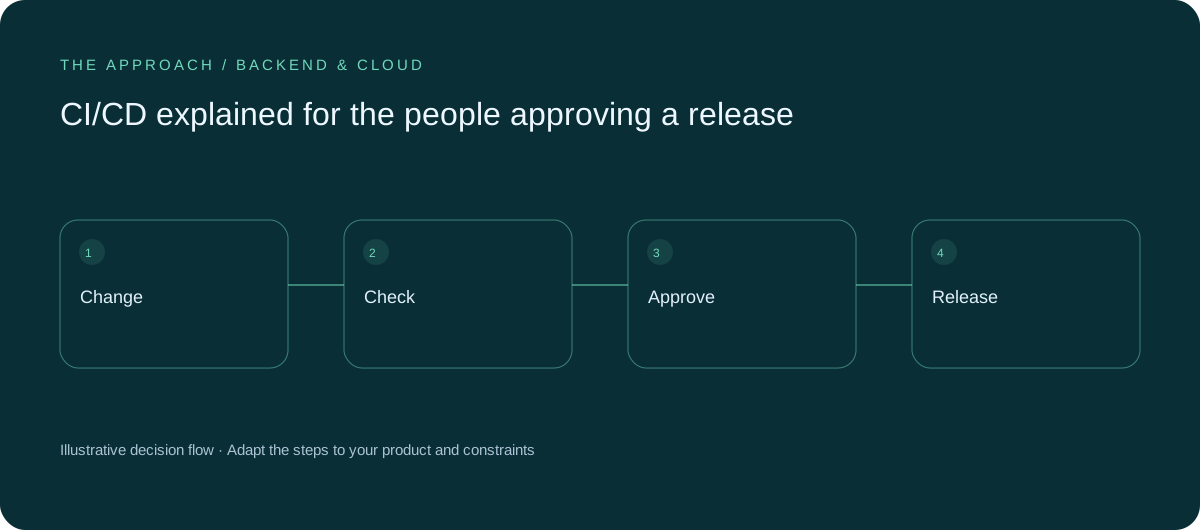
Continuous integration checks changes together; delivery automation prepares software for a controlled path towards production. The exact process varies. What matters to a business owner is knowing which checks ran, what version is being reviewed and who may authorise deployment. Automation should make those answers clearer rather than hide decisions behind a technical dashboard.
Use repeatable environments
Keep development, testing and production configuration separate. Build in a reproducible way and avoid manually editing production files as a normal release method. Protect secrets through appropriate configuration management. A test environment should be useful enough to reveal important behaviour without becoming an uncontrolled copy of private customer data.
Choose meaningful gates
Prioritise tests around permissions, payments and core tasks. Include review for changes that automation cannot assess well. A long pipeline is not automatically a strong one; checks should provide evidence relevant to the release risk. Make failures understandable and assign ownership so a broken pipeline does not become something everyone ignores.

Prepare the return path
Record the released version and know how to roll back or disable a problematic feature. Database changes may need special planning because reverting code does not necessarily reverse stored data. Agree who watches the initial rollout and what signals trigger action. A release is complete when the service is operating as intended, not just when deployment finishes.
Your next working session.
- Identify the release owner
- Keep configurations separate
- Test rollback assumptions
Bring one real, anonymised example to the discussion. Work through the choices above with the person responsible for the outcome, record the unresolved questions and agree who will investigate them.
Elite Apps editorial · Practical planning guidance. Examples and diagrams are illustrative; implementation depends on your requirements. Technical and supplier guidance can change.