Choose signals that reveal broken customer journeys without building a wall of unused charts.
Start with customer impact
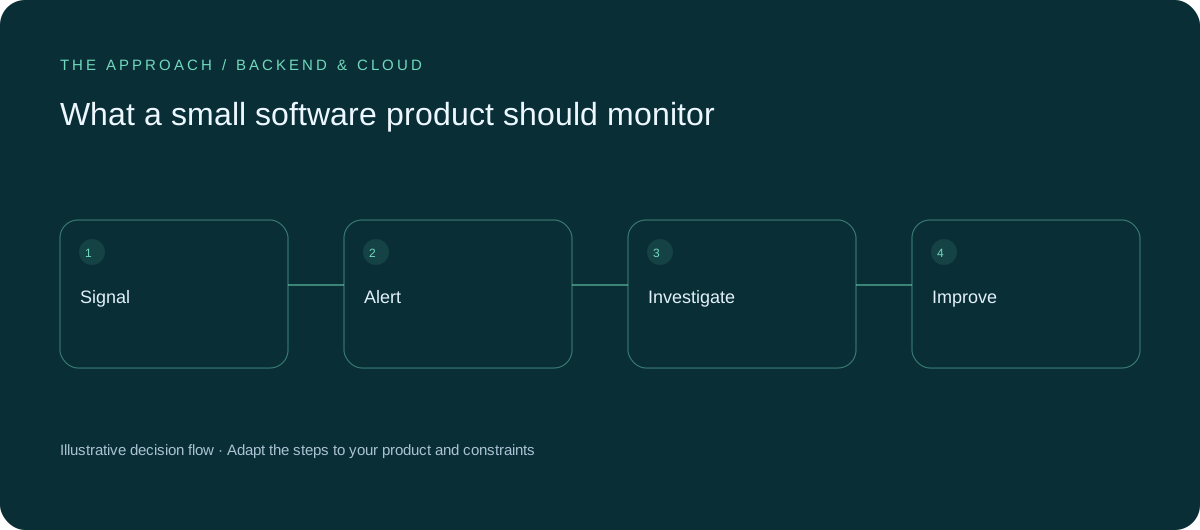
An application can be technically online while every booking fails. Monitor the outcomes the business depends on, such as completed requests and failed integrations. Pair those signals with infrastructure health. A useful alert tells an owner that something needs action, not simply that a number moved outside an arbitrary threshold.
Connect logs to a request
Use a consistent request or operation identifier to trace work across services. Record meaningful errors without leaking secrets or unnecessary personal data. Too much logging can bury the useful evidence and increase costs. Decide which details are needed to diagnose common failures and how long they should remain available.
Design actionable alerts
State the affected service, likely impact and first diagnostic step. Route the alert to someone responsible during defined coverage hours. Review repeated noise and unresolved warnings. If staff routinely ignore an alert, investigate whether its threshold, ownership or meaning is wrong rather than assuming more alerts will help.

Review the operating story
After an incident, compare what users experienced with what monitoring revealed. Add a missing signal only when it would have improved detection or diagnosis. Keep dashboards small enough to use during pressure. The goal is a team that understands the service, not a monitoring platform with impressive but disconnected graphs.
Your next working session.
- Monitor business outcomes
- Trace operations safely
- Assign alert owners
Bring one real, anonymised example to the discussion. Work through the choices above with the person responsible for the outcome, record the unresolved questions and agree who will investigate them.
Elite Apps editorial · Practical planning guidance. Examples and diagrams are illustrative; implementation depends on your requirements. Technical and supplier guidance can change.