A practical starting point for connecting your business tools without overlooking the messy details.
Identify the source of truth
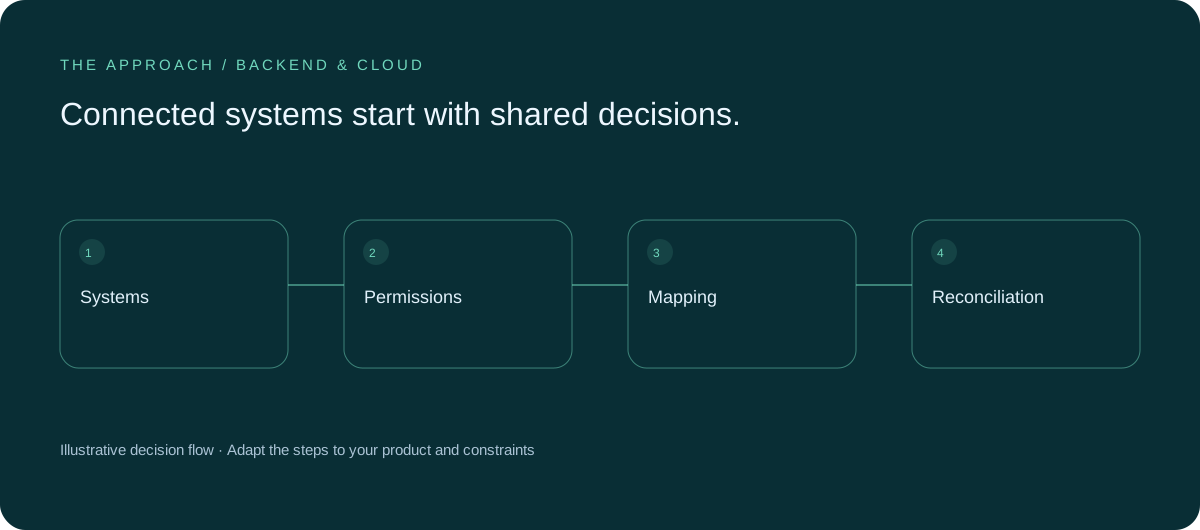
For each important record, decide which system is authoritative. Customer details, stock availability and payment status may each have different owners. Document which system can create or update a field, and what should happen when information disagrees. This is a business decision as much as a technical one.
Map the full journey
Follow a real task across the systems involved. Include cancellations, edits, failed payments and missing information. A diagram of the successful path helps, but the exceptions reveal how the integration will behave during ordinary operational pressure. Ask the people doing the work where they currently make manual corrections.
Check the connection before committing
Review whether the vendor provides a supported API, which permissions are available and what the contract allows. Investigate test environments, usage limits and the availability of the fields you need. Avoid assuming that two products can exchange every piece of information simply because both advertise an integration capability.

Plan reconciliation and recovery
Agree how the team will spot records that have not arrived, how duplicate updates are handled and who resolves mismatches. Decide what users see when a connected service is unavailable. For consequential data, include a way to reconcile the final result against the source rather than relying only on a successful request message.
Start with a bounded flow
Choose one useful connection and test it with representative, non-sensitive examples. Define acceptance criteria covering the expected path and the important failures. Expand after the team understands the operational behaviour. Document the connection and its owner so future changes to either system can be assessed deliberately.
Your next working session.
- Verify API access
- Assign data ownership
- Plan failure handling
Bring one real, anonymised example to the discussion. Work through the choices above with the person responsible for the outcome, record the unresolved questions and agree who will investigate them.
Elite Apps editorial · Practical planning guidance. Examples and diagrams are illustrative; implementation depends on your requirements. Technical and supplier guidance can change.