Find the constraints, preserve useful behaviour and replace the parts that justify change.
Understand what already works
Existing software often contains business knowledge absent from its documentation. Speak with users and inspect operational exceptions. Identify stable capabilities as well as pain points. A complete replacement can accidentally discard useful behaviour that was never written into the new brief. Begin with evidence, not the assumption that old technology must be replaced immediately.
Locate the constraint
Problems may come from an unreliable integration, confusing workflow or slow query rather than the whole platform. Review code, dependencies, data and release capability. Distinguish a maintainability issue from a user-experience problem. The diagnosis should explain why a proposed intervention will improve the outcome rather than simply make the stack more fashionable.
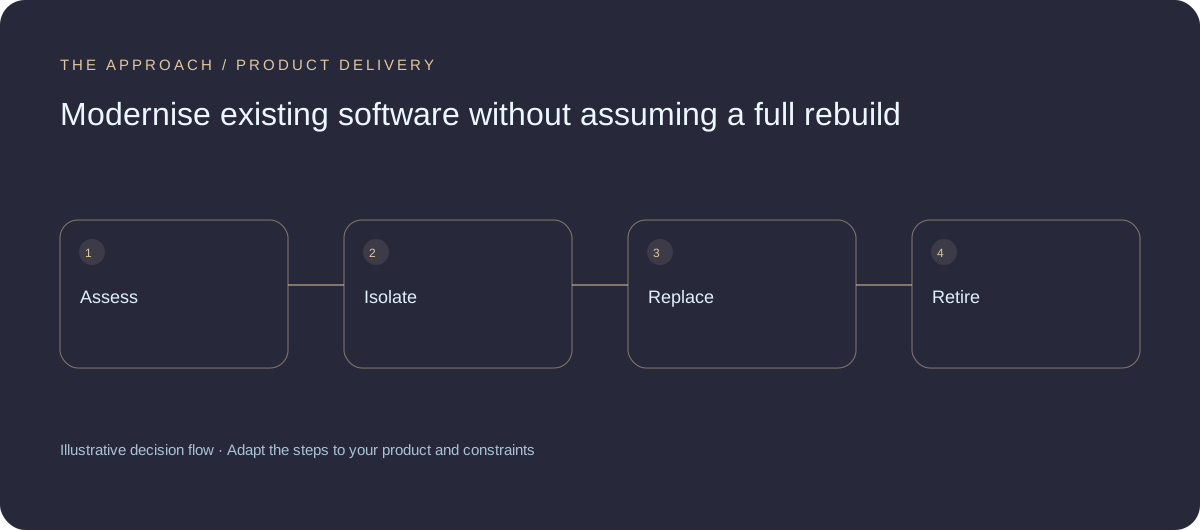
Consider incremental replacement
Where feasible, improve one boundary or journey at a time. Keep interfaces and data ownership clear between old and new components. Plan reconciliation and rollback. Incremental work reduces some risks but introduces coordination needs; it is not automatically simpler. Compare it with a rebuild using the system’s actual constraints and business continuity requirements.

Protect migration knowledge
Test important existing behaviours and document intentional changes. Agree how users move, how records are reconciled and when the old path is retired. A modernisation succeeds when the business can operate better with sustainable software, not merely when the new repository uses a newer framework.
Your next working session.
- Document valuable behaviour
- Diagnose the constraint
- Plan coexistence and retirement
Bring one real, anonymised example to the discussion. Work through the choices above with the person responsible for the outcome, record the unresolved questions and agree who will investigate them.
Elite Apps editorial · Practical planning guidance. Examples and diagrams are illustrative; implementation depends on your requirements. Technical and supplier guidance can change.